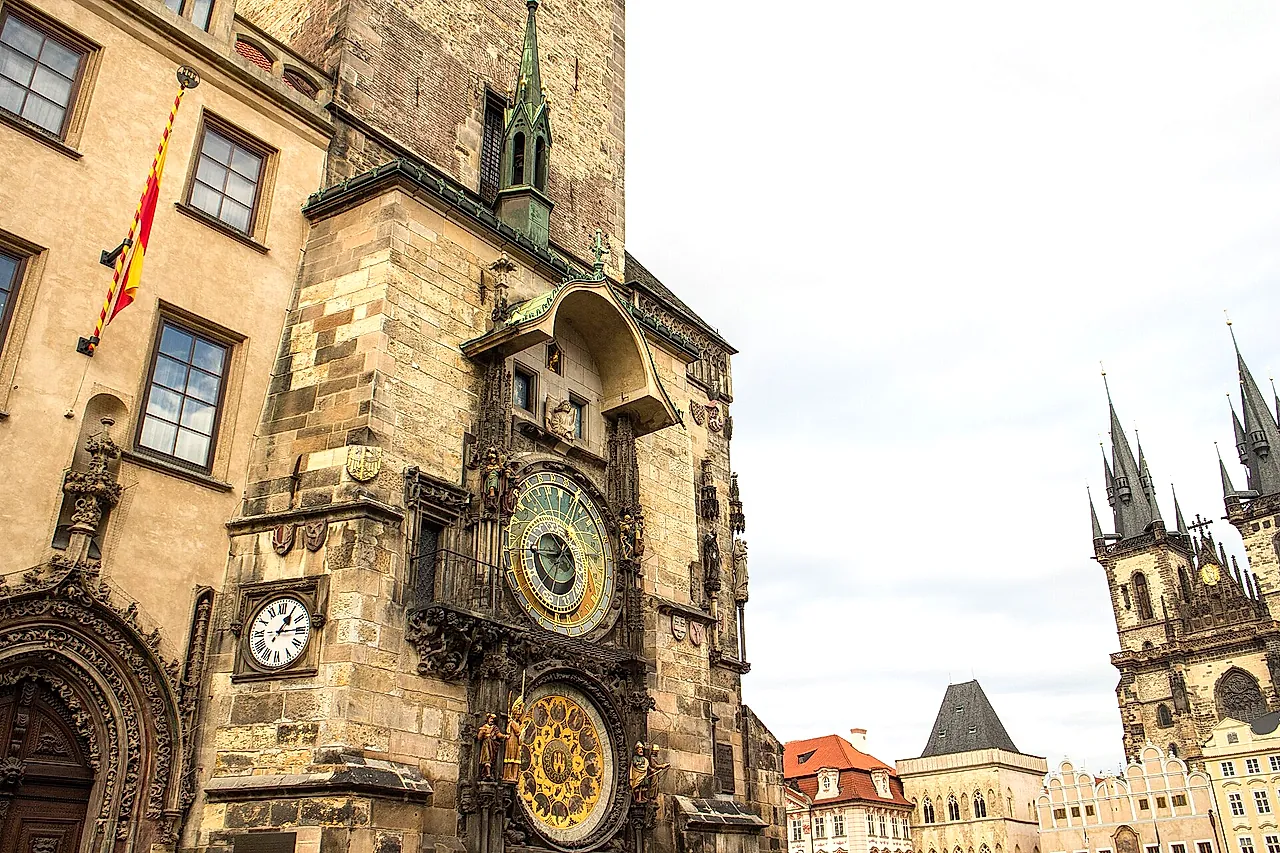
Prague · Old Town Square · Orloj, tower, historic interiors
Old Town Hall and Astronomical Clock: tickets, hours and highlights
The Gothic town hall tower on Old Town Square, with the astronomical clock whose twelve apostles appear every hour. Opening hours, what each ticket covers and how to get there.
Today
Opening hours for every month are on the Opening hours page.
Checked against the official website on 24 October 2026 · Official source
In short
- The tower and the historic interiors are different parts of the visit. The interiors (a chapel, representative halls and an underground level) are visited on guided visits sold on site on the day, and the lift in the tower is an extra. According to the operator, the tower is 69.5 m high, and the climb is described as demanding.
- It is open every day: from 9:00 to 20:00 from April to December and from 10:00 to 19:00 from January to March. The official site publishes no last-entry time.
- The astronomical clock, the Orloj, is on the south side of the tower, in the square. The twelve apostles appear every hour; the official site and other sources disagree on the first and last hour of the show, so we do not give one.
- The tickets page lists the tickets and tours sold by our partner, a third party: a tower-only ticket, a clock-tower entry with an introduction, a walking tour with the tower, an audio guide for the square and, nearby, Jewish Quarter visits, the Charles Bridge towers and river cruises. The tower-only ticket does not include the historic interiors.
The Orloj, the astronomical clock
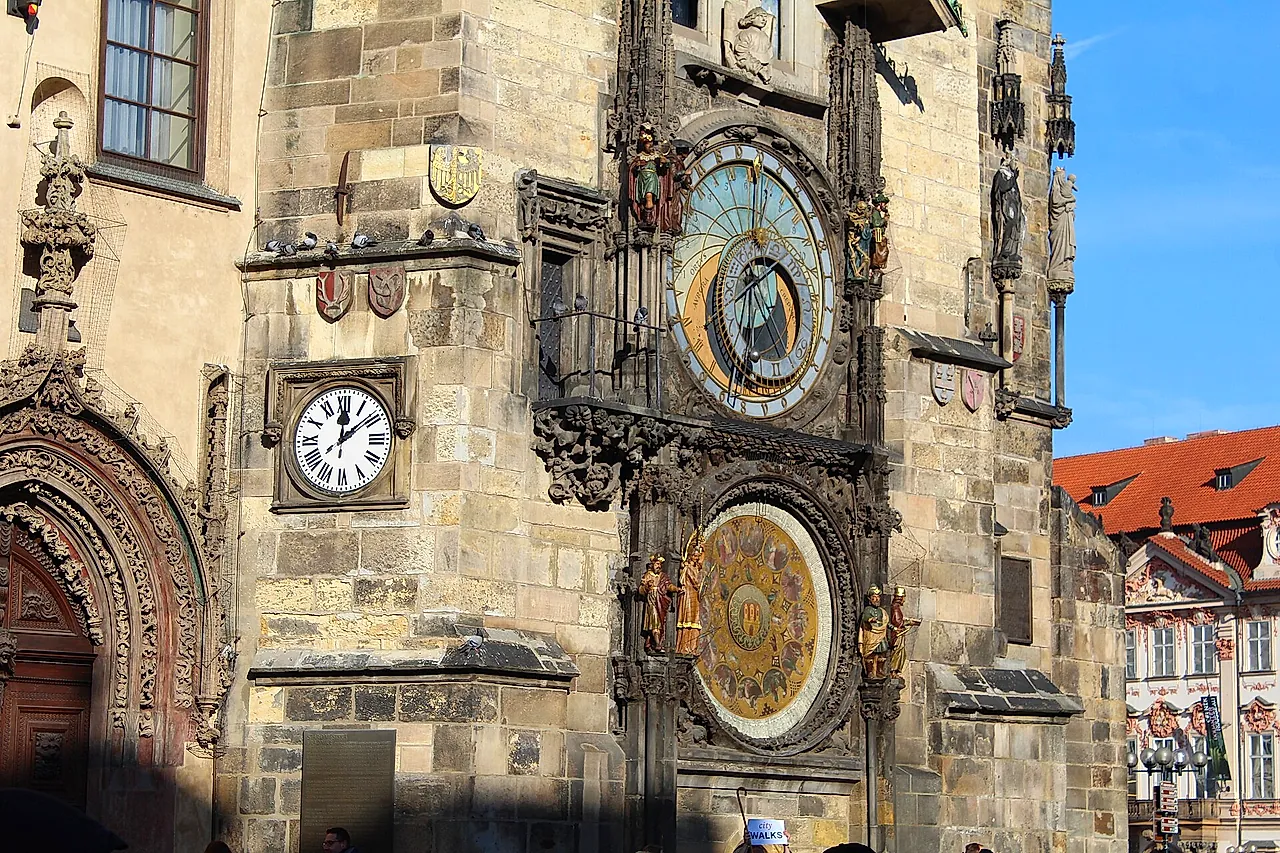
The clock has three parts: the mechanical figures at the top, the astronomical dial with the zodiac, and the calendar below. According to the operator of the Old Town Hall, it was built in 1410 by Mikuláš of Kadaň and improved at the end of the 15th century by Master Hanuš. Guides printed around 1900 gave a different account: Baedeker (1911, p. 296) wrote that it “dates from 1490”, and Lützow (1902, p. 168) said it was built in 1490 by Hanuš. That date reflects an older tradition, and we follow the operator’s dates.
The dial shows four kinds of time: Central European, Old Bohemian (the day starts at sunset), Babylonian (unequal hours) and sidereal. The calendar with the allegories of the months is the work of Josef Mánes (1865); the original is in the Museum of the City of Prague, and the one on the town hall is a copy by Bohumil Číla (1946).
The show on the hour
Every hour the twelve apostles appear in the two windows under the little roof. Death, as a skeleton, pulls a cord to start the show. The Turk shakes his head, the Miser shakes his stick and the Vain Man looks into a mirror. At the end the rooster crows and the clock strikes. The apostles are wooden figures carved by Vojtěch Sucharda in 1948, replacing those destroyed in the fire of May 1945.
The sources we read differ on the first and last show of the day, so we say only that it happens every hour: arrive a few minutes early and check on the day.
The tower and the town hall
The Old Town Hall was established in 1338 with the consent of King John of Luxembourg, and its chapel dates from 1381. According to the operator, the tower is 69.5 m high, completed in the 14th century, and its Gothic gallery is at 42 m. The operator’s standard visit covers the tower and the Knights’ Hall, where there is an exhibition about a bell and a 3D digital model of the Orloj. The operator’s page also describes the historic interiors, with a chapel, representative halls and an underground level, which can be visited on guided visits.
In May 1945 the town hall was shot at and set on fire during the Prague uprising. The neo-Gothic east wing was destroyed and never rebuilt, and the tower and the chapel were badly damaged.
The clock’s story and the legend
The operator tells the best-known legend as a legend: that the councillors had Master Hanuš blinded so that he could not build another clock, and that he took revenge by stopping it. What is documented, according to the operator, is that the clock really stopped in 1865 and was in danger of being removed, until the Prague clockmaker Ludvík Hainz repaired the mechanism and became its keeper. The clock was repaired and restored again from September to November 2005.
The square in front
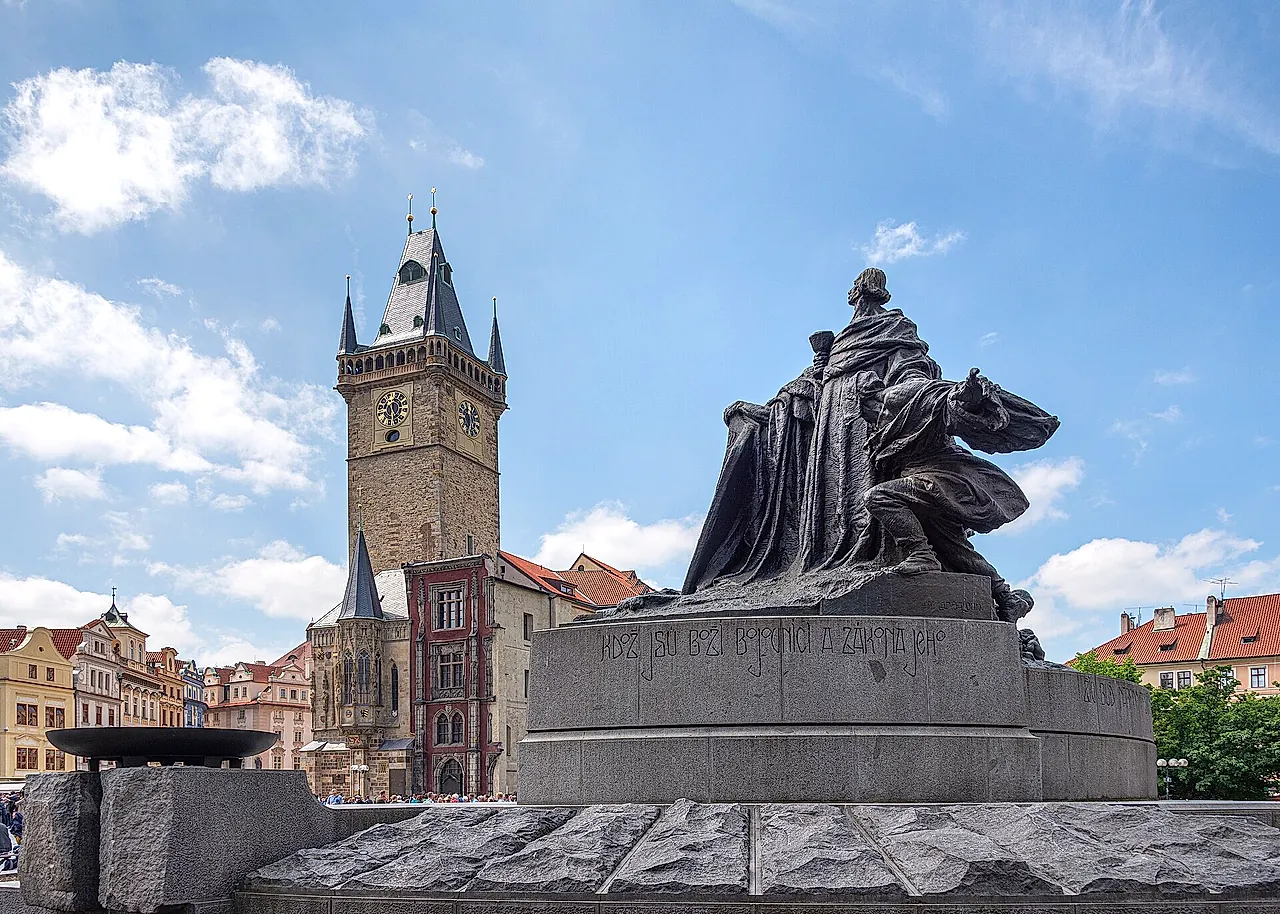
Old Town Square is pedestrian: the operator’s page on the square says trams were removed in 1960 and buses in 1967. On 21 June 1621, 27 leaders of the uprising were beheaded in front of the town hall, and crosses in the pavement mark the place.
Visitor guide
Prague Attraction Tickets: Castle, Orloj, Petřín, Žižkov
How to choose a Prague ticket: entry, audio guide, tour, combined, concert, city pass or cruise, plus hours and access rules for the five main sights.
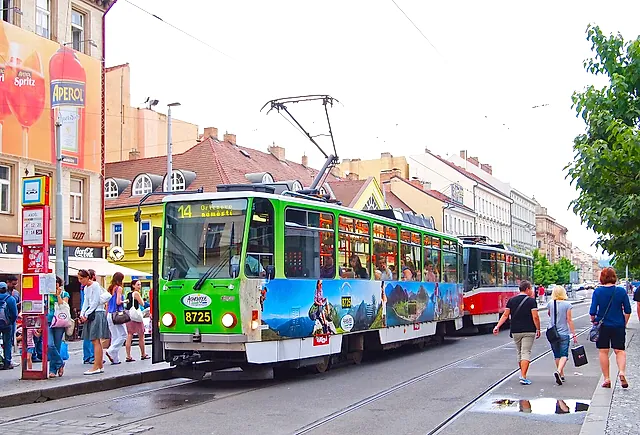
Getting Around Prague: Airport, PID Tickets, Trams to the Castle
How to reach Prague's main sights: airport buses and metro, PID ticket prices, tram 22 to the Castle, Petřín funicular, Žižkov and the Museum of Communism.